DermaFusion
On-device skin-lesion classification · Research prototype
Native SwiftUI app that runs a two-model EfficientNet-B4 ensemble as FP16 Core ML packages, so photos are analyzed entirely on iPhone with no cloud, sign-in, or analytics.
- AUROC
- 0.830
- Top-3 accuracy
- 95.4%
- Training images
- 61,694
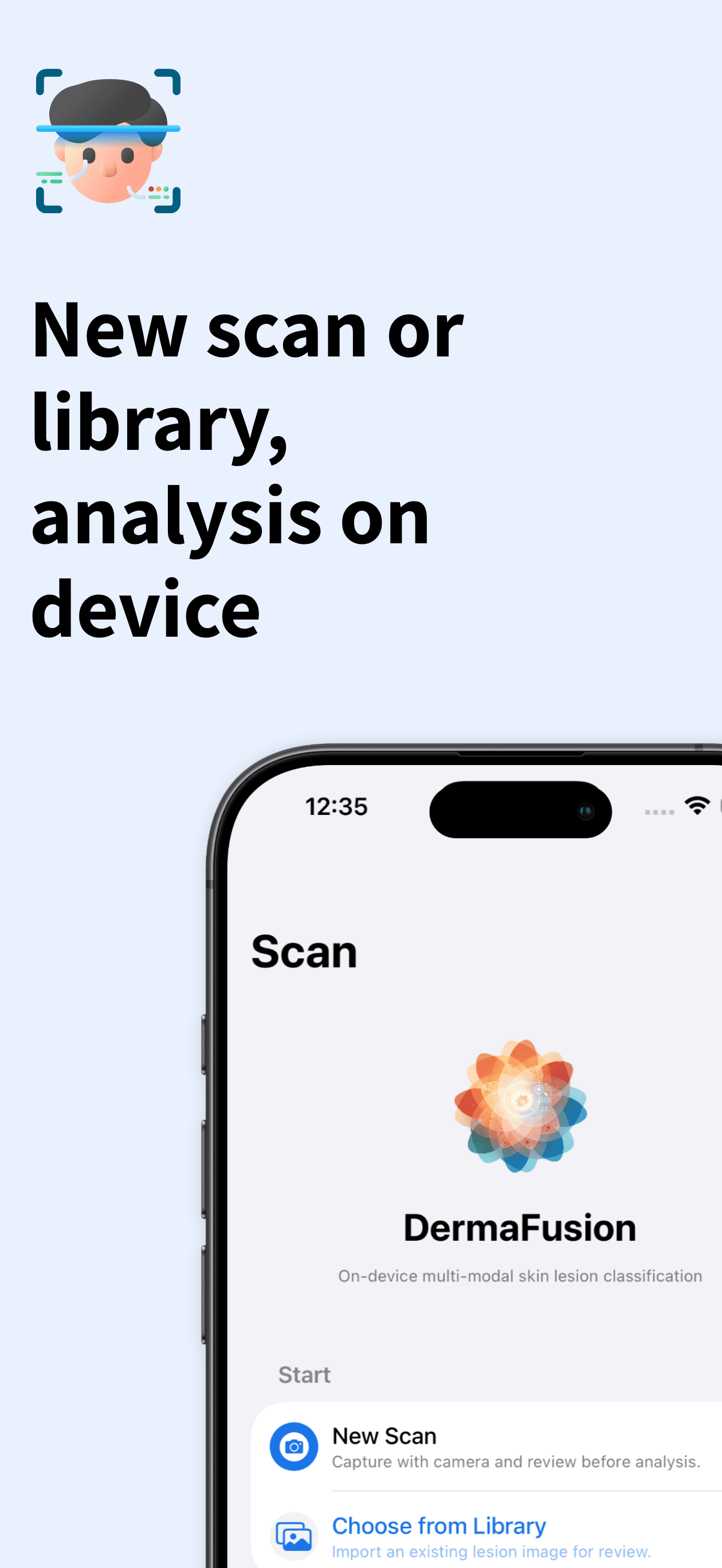
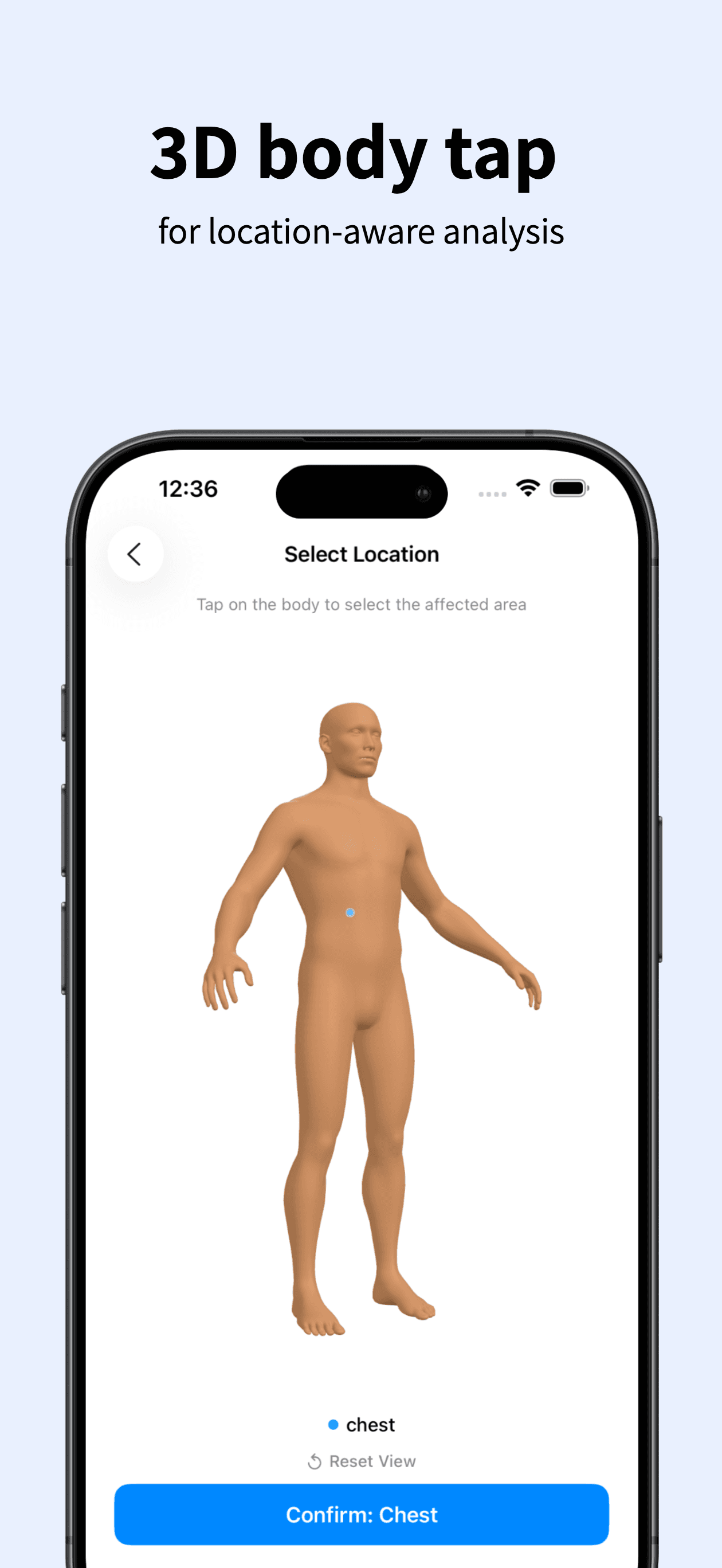
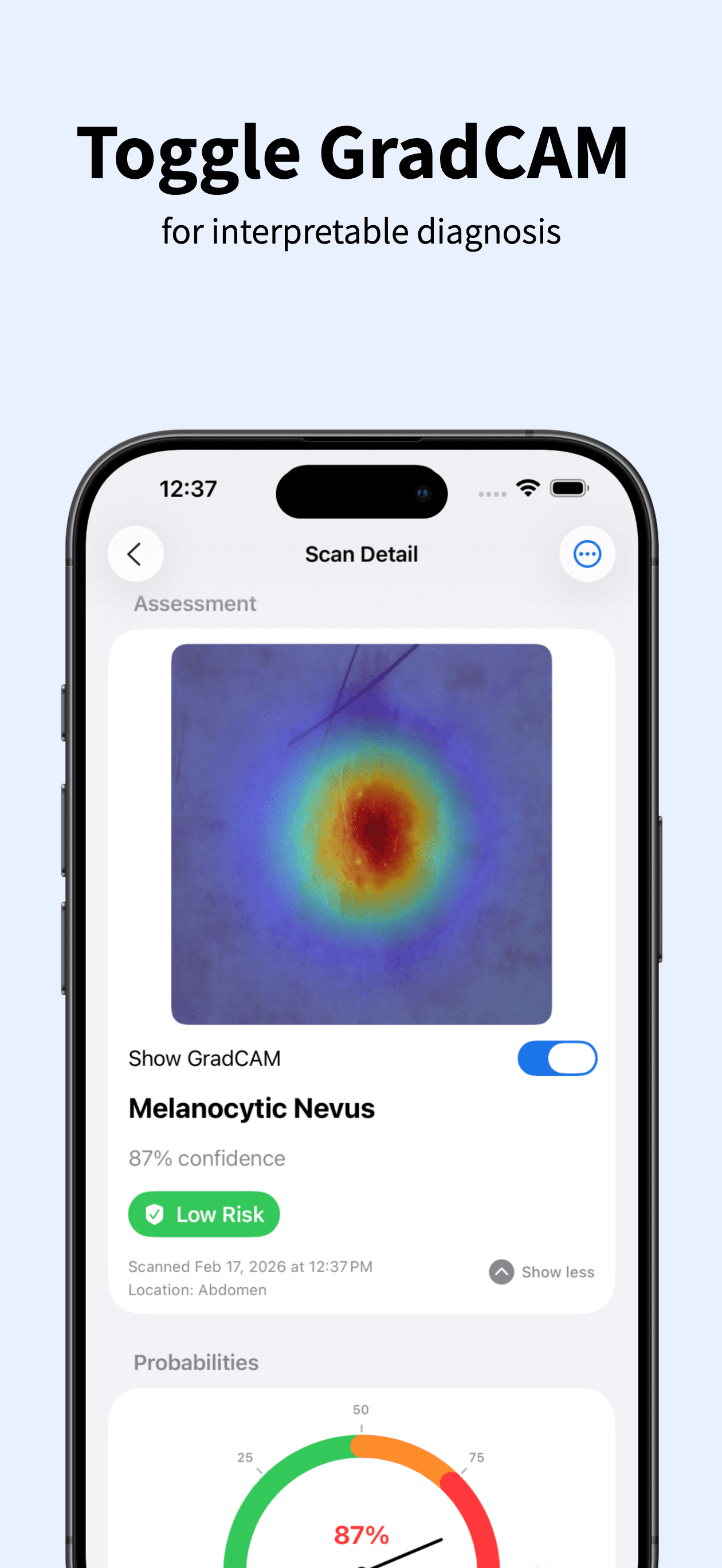
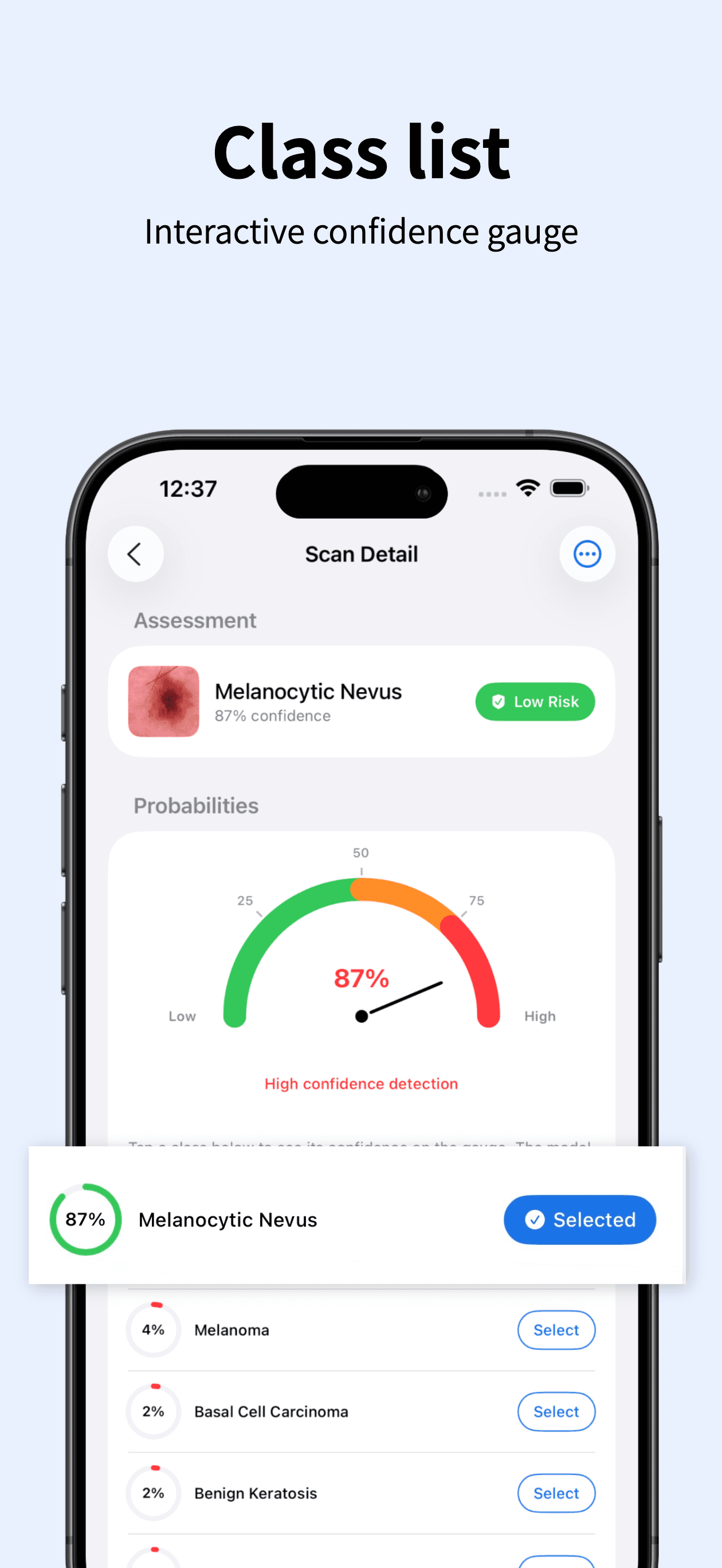
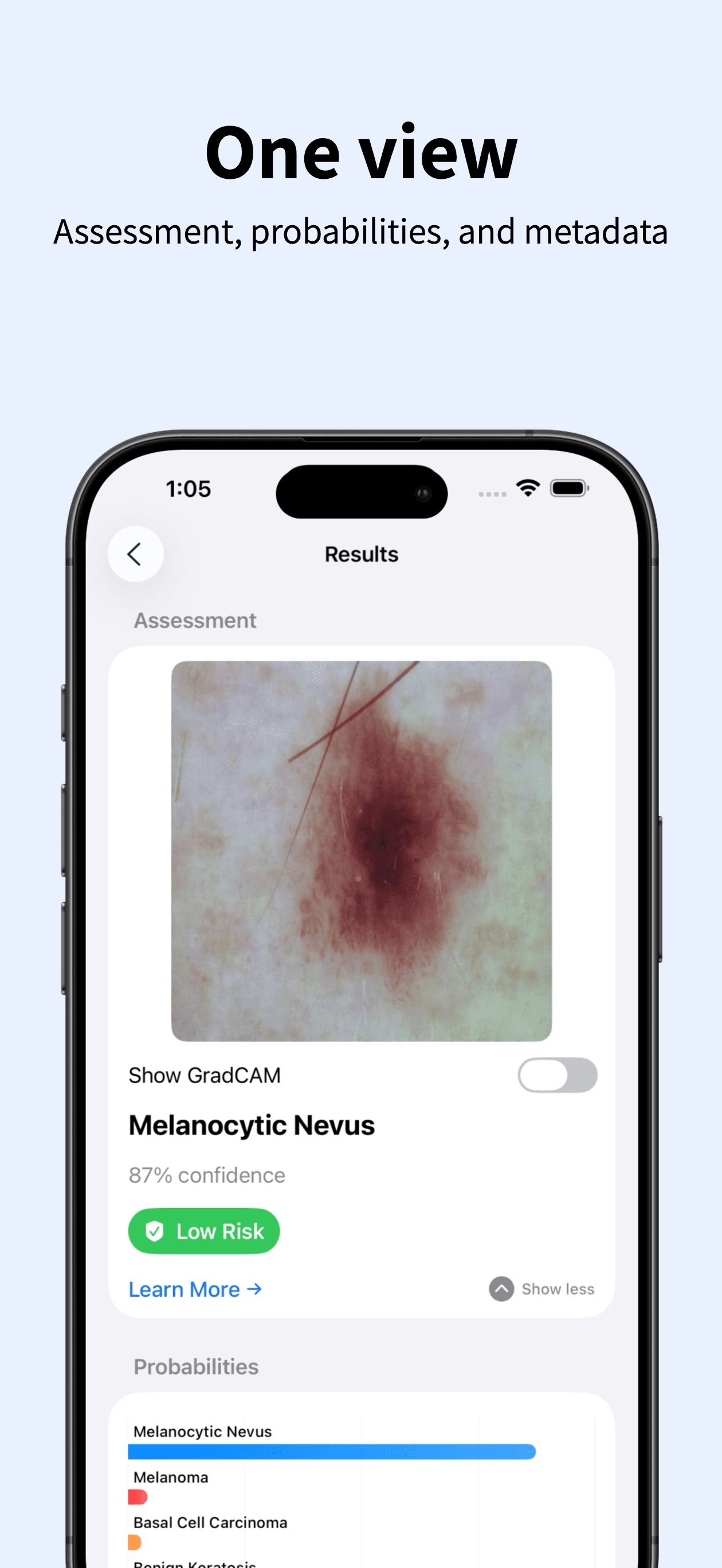
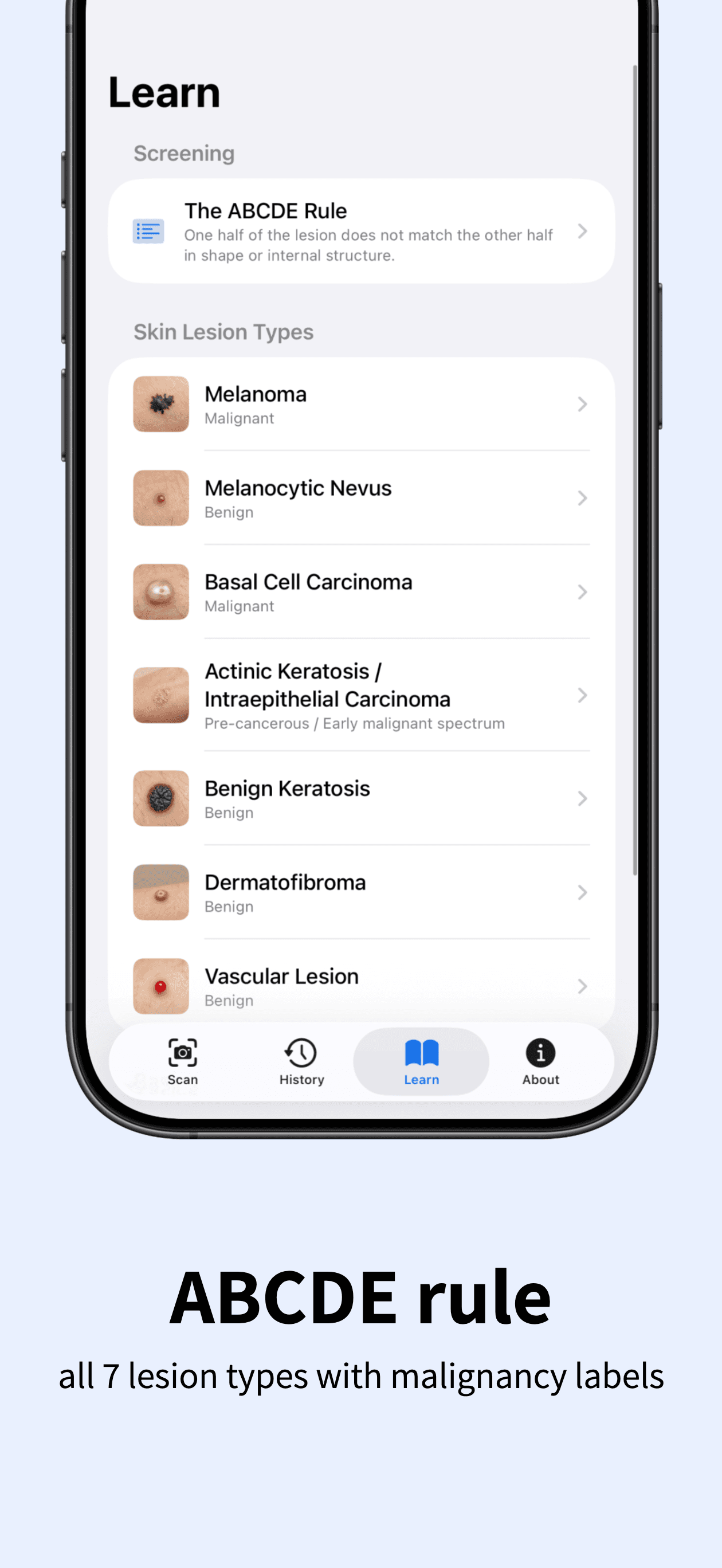
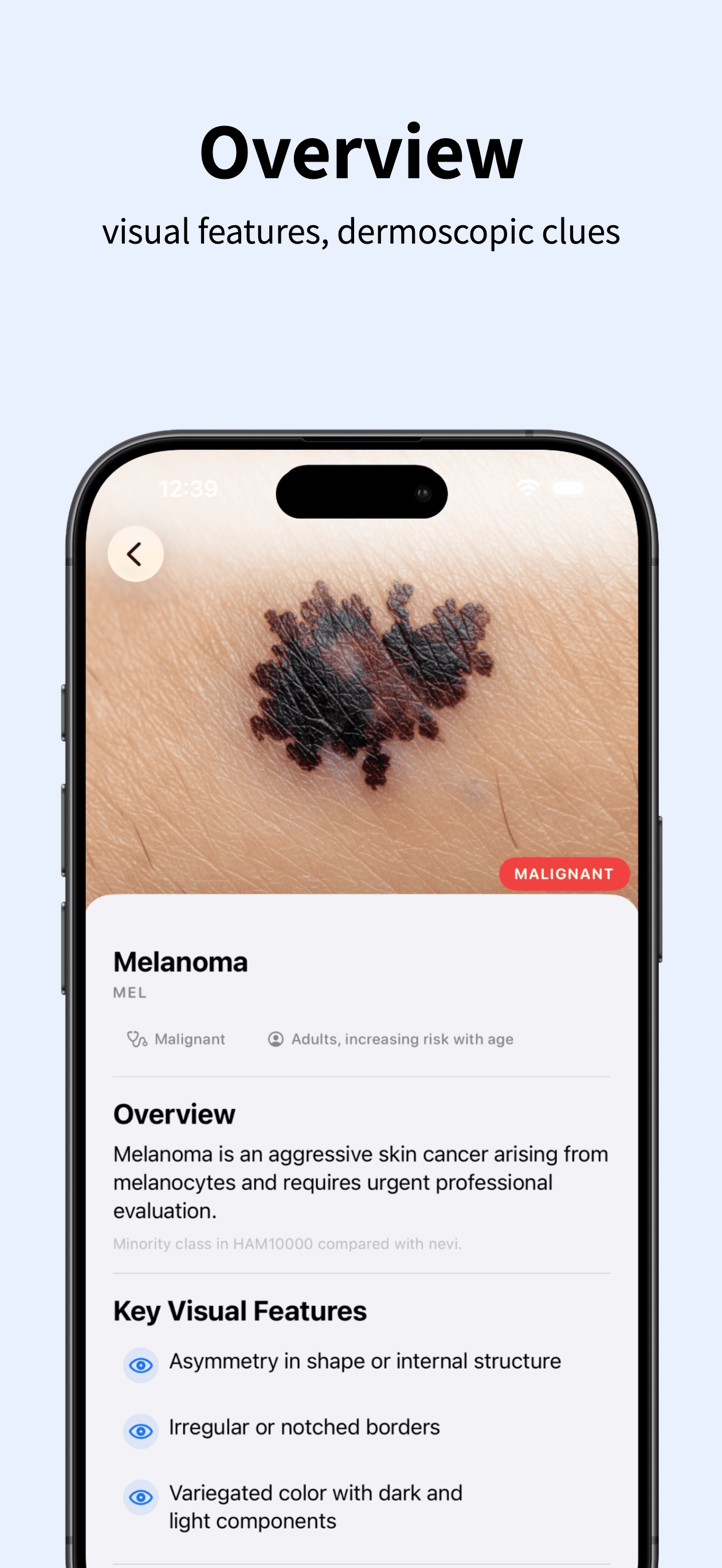
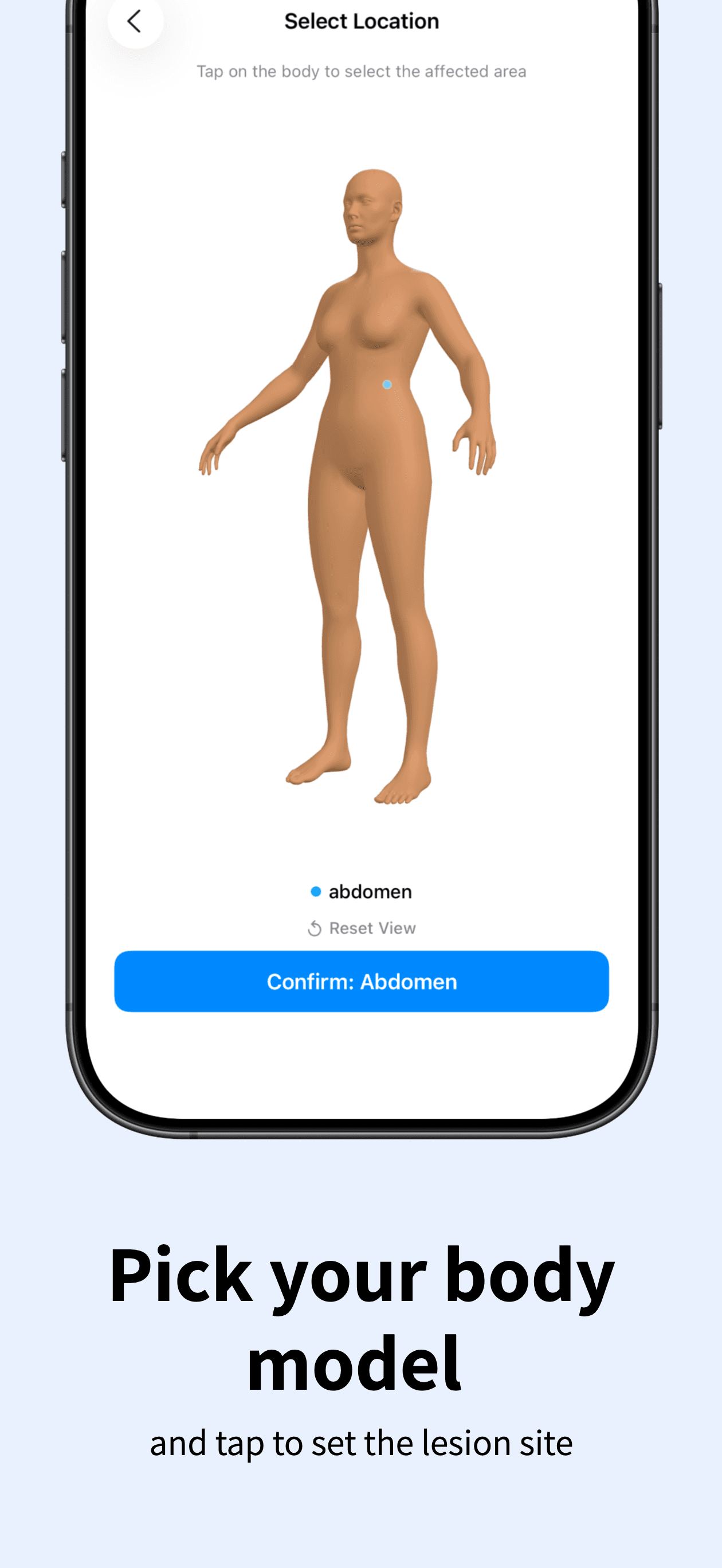
DermaFusion screens.
Overview
Camera capture and photo import, non-skin image rejection, Grad-CAM heatmap overlays, a malignant-risk gauge, and PDF report export through the share sheet. Designed for educational research, not as a medical device.
What I built.
- 01Two-model EfficientNet-B4 ensemble deployed as FP16 Core ML packages (34 MB each), fully on device
- 02Camera capture, photo import, non-skin image rejection, Grad-CAM overlays, a malignant-risk gauge, and PDF report export
- 03Trained on 61,694 dermoscopic and smartphone images unified from ISIC 2018/2019/2020 and PAD-UFES-20
- 04Patient-grouped splits with zero patient or lesion overlap, Shades-of-Gray color constancy, and DullRazor hair removal
- 05Class-balanced focal loss, MixUp, EMA, Dirichlet-tuned ensemble weights, and per-class thresholds
- 060.830 malignant-vs-benign AUROC and 95.4% top-3 accuracy on a 5,279-image held-out test set, verified through automated clinical-readiness gates
Project details
In depth.
Multi-source deep learning for 8-class skin-lesion classification (MEL, NV, BCC, AKIEC, BKL, DF, VASC, OTHER), trained on four public dermatology datasets and deployed as both a Gradio research demo and a native iOS app.
DermaFusion is an educational and research tool — not a medical device, not FDA approved, and not a substitute for professional medical advice.
Headline results
Final E0 + E3 soft-vote ensemble (EfficientNet-B4 × 2, 380 × 380), TEST set n = 5,279, 1,000-iter bootstrap 95 % CI:
| Metric | Value (95 % CI) |
|---|---|
| 8-class Balanced Accuracy | 0.540 [0.509, 0.568] |
| 8-class Macro F1 | 0.469 [0.441, 0.495] |
| Top-1 / Top-2 / Top-3 accuracy | 0.778 / 0.907 / 0.954 |
| Binary-malignant AUROC | 0.830 |
| Sensitivity @ 95 % specificity | 0.462 |
Architecture summary
| Stage | Description |
|---|---|
| Data | ISIC 2018 / 2019 / 2020 + PAD-UFES-20 → 61,694 dermoscopic + smartphone images, 8 unified classes |
| Splits | Patient-grouped (GroupShuffleSplit on patient_id → lesion_id) + iterative leakage enforcement → TRAIN 52,483 / VAL 3,932 / TEST 5,279, zero patient/lesion overlap |
| Preprocessing | Shades-of-Gray (power = 6) + DullRazor + 380 × 380 |
| Backbone | EfficientNet-B4 (~17.6 M params) — two members trained from different starting points |
| E0 | efficientnet_b4, CB-Focal (γ = 1.5) + MixUp + TrivialAugmentWide + EMA 0.999, √-inv sampler |
| E3 | tf_efficientnet_b4.ns_jft_in1k, class-balanced focal (γ = 2.0), full-inverse sampler |
| Ensemble | Soft-vote, Dirichlet-optimised weights [0.705, 0.295], per-class thresholds tuned on VAL macro-F1 |
| Deployment | Gradio (single 142 MB ensemble bundle) + iOS (two FP16 .mlpackage files, 34 MB each) |
iOS app: how it works
- Capture / import a close-up of a skin lesion (camera with guided framing, tap-to-focus, macro-lens preference; or photo library).
- Preflight (
LesionPreflight) — Vision structural detectors (text / face / animal / barcode) + a color/quality sanity gate. Non-lesion photos are rejected with actionable guidance before inference. - Inference — an on-device EfficientNet-B4 soft-vote ensemble (
E0+E3) produces a probability distribution over 8 lesion categories. Everything runs locally via Core ML / the Apple Neural Engine; nothing is uploaded. - Results — probability chart, malignant-risk gauge, and a Grad-CAM-style attention overlay; optional PDF export; local scan history (SwiftData, file-protected, excluded from iCloud backups).
Privacy
No accounts, no networking code, no analytics / telemetry / ads / third-party SDKs. Images and results stay on the device.
Clinical readiness gates
Full-split validation runs against the deployment bundle, and a readiness report turns the results into pass/fail checks. The default screening_v1 profile checks sample size, top-1 / balanced accuracy / macro-F1, MEL triage sensitivity / specificity / NPV, and class recall for MEL / BCC / AKIEC.
References
- ISIC 2018 Task 3 — https://challenge.isic-archive.com/landing/2018/
- ISIC 2019 — https://challenge.isic-archive.com/landing/2019/
- HAM10000 — Tschandl et al., Scientific Data (2018)
- PAD-UFES-20 — Pacheco et al., Data in Brief (2020)
- Shades-of-Gray colour constancy — Finlayson & Trezzi (2004)
- DullRazor hair removal — Lee et al. (1997)
- Class-balanced focal loss — Cui et al., CVPR (2019)
Tech specs
Under the hood.
- SwiftUI
- Core ML
- Vision
- PDFKit
- PyTorch
- EfficientNet-B4
- Grad-CAM
Designed for educational research, not as a medical device.